
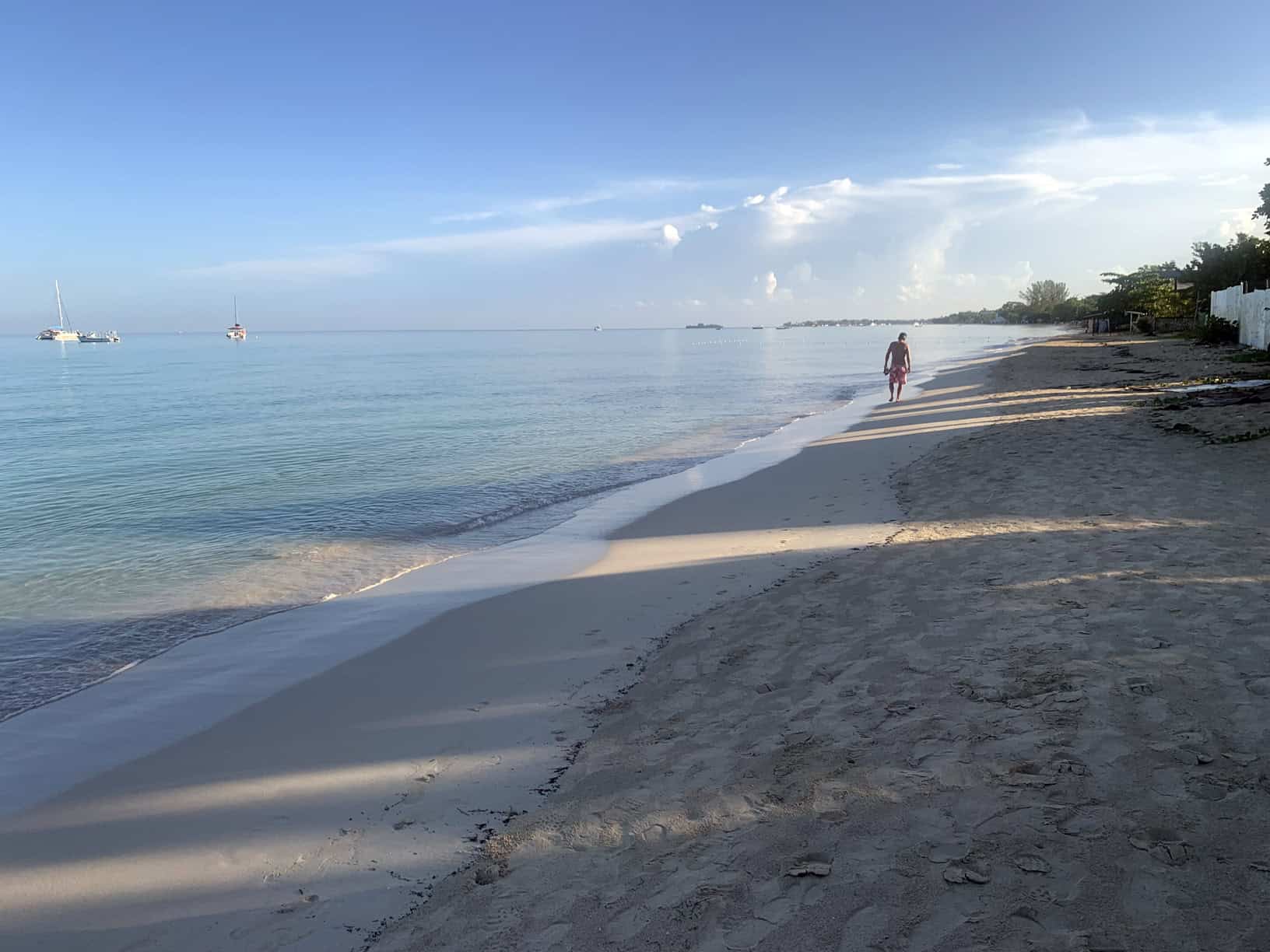
Jamaica’s Public Beaches Are Disappearing: What Visitors and Locals Need to Know
Last Updated: June 2026
Jamaica has approximately 148 miles of sandy beach across 494 miles of coastline. According to the grassroots organization JaBBEM (Jamaica Beach Birthright Environmental Movement), less than 1% of that coastline is freely accessible to Jamaican citizens. The root cause is the Beach Control Act of 1956, a colonial-era law that vests ownership of all foreshore (the strip of sand between high and low tide) in the Crown and grants no general public right to access the beach. This law has enabled decades of beachfront privatization, primarily by all-inclusive resort chains, that has systematically cut Jamaicans off from their own coastline. In March 2026, Prime Minister Andrew Holness tabled a new Beach Access and Management Policy in Parliament, but advocacy groups argue it reinforces the problem rather than solving it. For visitors to Negril, the situation is different: 7 Mile Beach remains one of the few fully walkable, publicly accessible stretches of coastline in Jamaica. This guide explains the law, the fight, what’s changing, and where you can actually go to the beach.
The Law: Jamaica’s Beach Control Act of 1956
The Beach Control Act is the foundation of Jamaica’s beach access crisis. Passed under British colonial rule, it declares that all rights over the foreshore and the floor of the sea are vested in the Crown. Section 3(4) states it plainly: no person shall be deemed to have any rights in or over the foreshore except those derived from this Act.
What this means in practice: the beach is not public land in Jamaica. It is Crown land, administered by the Commissioner of Lands, who sits in the Office of the Prime Minister. The government can issue beach licenses to private operators, including hotels and resort chains, granting them exclusive use of the foreshore. Once a license is granted, a resort can legally restrict who walks on the sand in front of their property.
This is fundamentally different from how other Caribbean islands handle beach access. In Barbados, the foreshore is public property and no resort can restrict access to it. In Antigua, all 365 beaches are public. The Dominican Republic’s constitution declares the first 60 meters of sand from the high tide mark as public domain. In St. Vincent and the Grenadines, beachfront property owners must provide public access to the beach and set structures back at least 12 meters from the high water mark. In St. Lucia, where developers recently attempted to erect “private beach” signs, mass community protests forced their removal within days. Mexico’s President signed a law in 2020 banning the blocking of public beaches entirely. In Australia, no person or organization can own the foreshore. In Hawaii, every beachfront property must provide public access. The US Virgin Islands mandate that all beaches are publicly accessible up to the vegetation line.
Jamaica lacks these protections. The Beach Control Act was never repealed after independence in 1962. It remains on the books in 2026, enabling exactly the kind of privatization its critics warned about seven decades ago. Ironically, the Act was itself a response to complaints in 1954 that fishermen were being squeezed off beaches. The law intended to solve that problem has made it worse.
What’s Happening Across Jamaica
The numbers tell the story. In major tourism hubs like Montego Bay, Ocho Rios, and Runaway Bay, nearly every prime stretch of beachfront is controlled by an all-inclusive resort. Sandals, Couples, RIU, Royalton, Iberostar, Half Moon, and others occupy the coastline wall to wall. In Montego Bay, JaBBEM measured 14 miles of coastline and found only approximately 4,000 feet freely accessible to the public across four beaches.
The losses are accelerating. Mammee Bay Beach in St. Ann, a beloved community beach used by locals for generations, was sold to a private developer in 2020 and fenced off during COVID lockdowns. The Roaring River swimming area was blocked when surrounding land was transferred to the China Harbour Engineering Company. Blue Lagoon in Portland, one of Jamaica’s most iconic natural attractions, has been effectively closed to traditional rafters for nearly three years after the Portland Municipal Corporation shut it down. Fishing communities have been displaced from beaches they worked for decades.
Five active court cases are currently seeking to secure beach access for Jamaicans, including disputes over Mammee Bay Beach, Providence Beach in Montego Bay (where Sandals plans overwater bungalows), Bob Marley Beach, Little Dunn’s River, and Blue Lagoon. JaBBEM is the plaintiff in several of these cases, partnering with fishing communities, vendors, and local residents.
The government lists 67 public beaches across the island. But many of these are closed, in disrepair, lacking facilities, or slated for divestment to private buyers. NEPA‘s own report acknowledges that “a significant number of these properties, due to limited public funding, have been left unattended, facilities have become derelict, some taken over by squatters and some affected by coastal erosion.”
A right or a managed privilege: the 2026 Beach Access and Management Policy
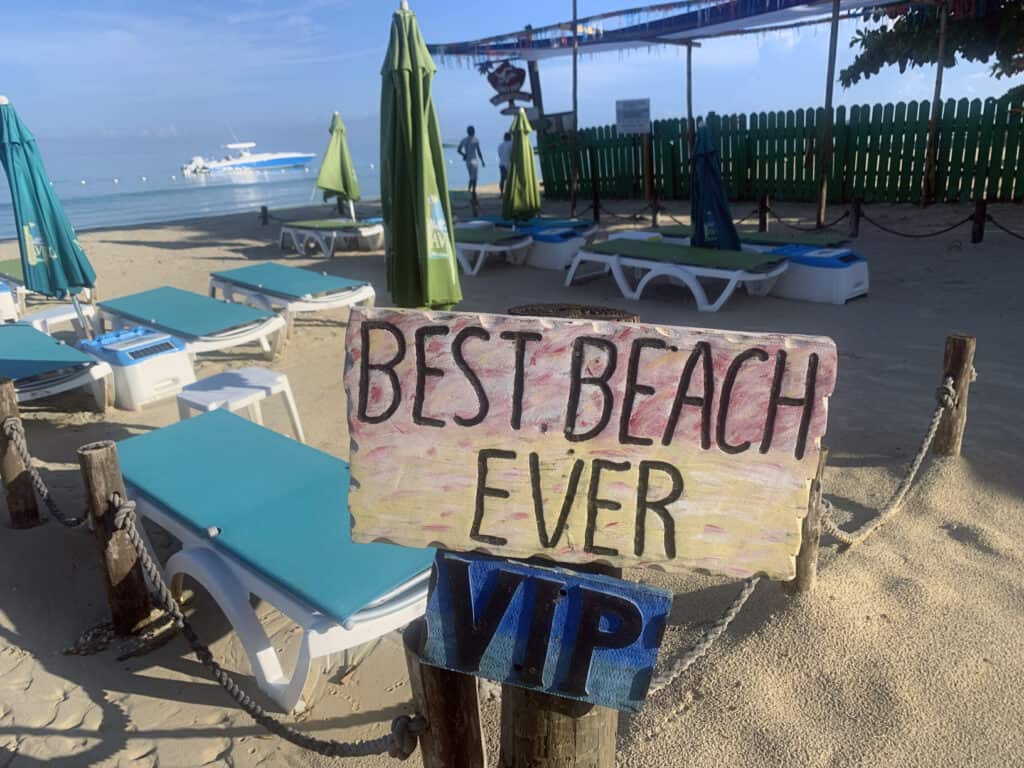
In March 2026 the Government formally tabled a Beach Access and Management Policy in Parliament, presented by the Prime Minister during the 2026/27 Budget Debate. The document had been in draft for years, first issued as a Green Paper in 2018 and revised in 2020, and the tabling marked the first formal step toward replacing the Beach Control Act of 1956. The Prime Minister told the House that the 1956 Act and its later amendment no longer addressed contemporary access concerns and would have to be replaced. The policy is a statement of intent rather than law. The Beach Control Act remains the governing statute until Parliament amends it.
At the centre of the policy is a question that has unsettled Jamaican coastal life for decades: whether access to the beach is a right or a managed privilege. The framework keeps a tiered system of beach categories. Public bathing beaches are free to enter. Public recreational beaches and commercial recreational beaches charge fees for entry or amenities, and the policy encourages hotels to operate beach-pass systems that would admit non-guests to hotel beaches for a fee. In its own wording, access does not necessarily connote free. That single line is the policy’s quiet centre of gravity, and most of the dispute around it flows from there.
The legal route by which ordinary Jamaicans have asserted a claim to contested beaches runs through the Prescription Act. Under section 4, where the public has used a beach for fishing, bathing or recreation, and has used a road or path to reach it, without interruption for twenty years, the public gains an absolute and indefeasible right to that beach and its access way. This is the mechanism behind a cluster of live court cases over closed or fenced beaches, including Mammee Bay and Little Dunn’s River in St Ann, the Blue Lagoon in Portland, Bob Marley Beach in St Andrew, and Flankers in St James, with the first trial set for the middle of 2026. Campaigners argue that prescriptive rights built over generations of use cannot simply be licensed away.
That is also why one provision draws particular alarm. The Jamaica Beach Birthright Environmental Movement, the coalition leading much of the opposition, warns that proposed amendments to the Prescription Act, which it links to the National Reconstruction and Resilience Authority Act passed in March 2026 to speed post-Hurricane Melissa rebuilding, could foreclose those customary rights before the courts rule on them. The movement has rejected the policy outright and called for its withdrawal rather than amendment.
Its objections are specific. It argues that access is framed as a conditional privilege rather than an inherent right, since the framework still allows government-managed public beaches to charge entry. It contends that the policy is aimed at the foreshore, the narrow strip between high and low water, and does not secure the dry sand above the tide line, which can remain private. It points out that where hotels can show ownership or exclusive rights the policy preserves them, leaving resorts that have held prime beachfront for decades in place. It notes that although a sale of a public beach would require cabinet approval, cabinet is the same body that has approved such sales before. It treats the number of public beaches drawn into the licensing framework, by its count sixty-seven, as enclosure of Crown land held in trust for the public, and says hotel beach passes ask Jamaicans to pay for land that is public by law. And it warns that provisions for artificial beach construction and exclusive licensing for overwater developments would accelerate coastal privatisation. The group has also set out an alternative: beach and river rights enshrined in the Constitution, a coastal protection zone above the high-water mark, a moratorium on new coastal construction, and a land trust to hold shore lands in perpetuity for the people of Jamaica.
The tourism industry frames the same facts differently. The Jamaica Hotel and Tourist Association argues that the real question is not whether Jamaicans should reach their beaches but how that access is managed. Its president, Christopher Jarrett, says unmanaged beaches often deteriorate through harassment, illegal vending, crime and poor sanitation, and that disorder at the coast would damage a tourism reputation built over decades. The association points to the property rights of homeowners and investors, and to the jobs and local livelihoods the sector supports, and it has called for a consensus approach that balances access, environmental stewardship, safety and investor confidence.
The Government, for its part, presents the policy as part of a wider effort to return value to citizens. The minister responsible, Matthew Samuda, has pointed to publicly built beach parks such as Harmony Beach Park in Montego Bay and a planned park at Success in St James, and to a requirement that some new developments on public land carve out corridors to the sea. He has also noted that Jamaica’s coastline is not all beach, with rocky stretches and protected wetlands that limit where public access can be created.
The dispute does not fall cleanly along party lines. The opposition’s environment spokesman, Omar Newell, has acknowledged that successive administrations of both parties presided over the loss of public beach access and said it must stop, and the coalition opposing the policy has stressed that it is not partisan. What remains unsettled, as the policy sits tabled and the first court cases approach, is the basic question the framework has reopened rather than resolved: whether the shoreline is a public birthright or a national asset to be managed, licensed and, in places, paid for.
Negril: The Exception That Proves the Rule
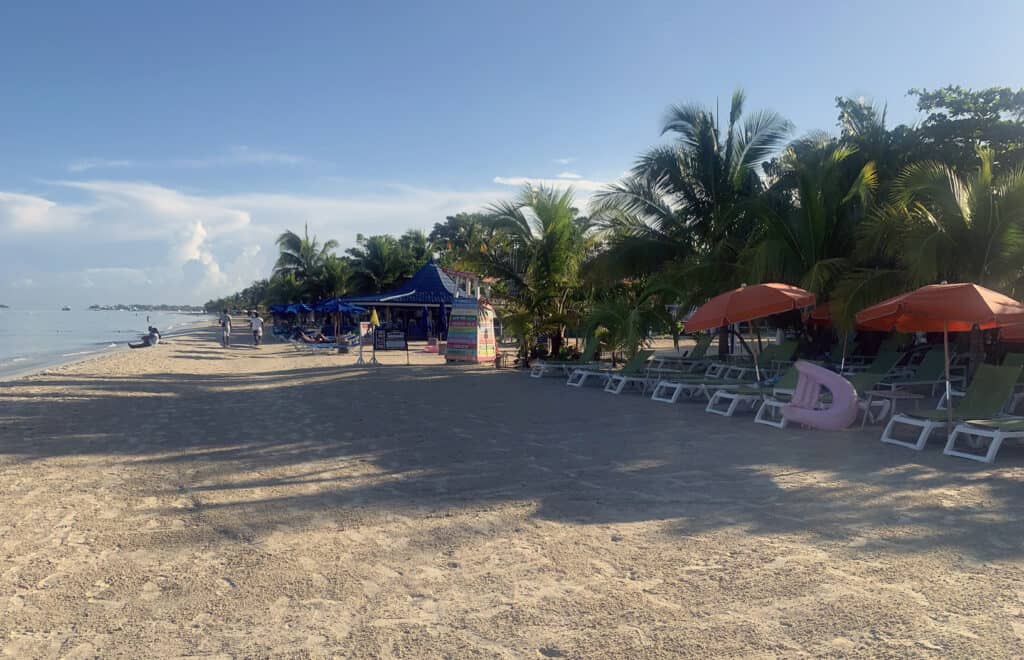
For visitors to Negril, the beach access situation is markedly different from the rest of Jamaica, and that is exactly why it matters.
7 Mile Beach (actually approximately 4.5 miles of walkable sand) remains one of the few stretches of coastline in Jamaica where you can walk the entire length without being stopped. No resort along Norman Manley Blvd can prevent you from walking across the sand in front of their property. You cannot set up on their lounge chairs or use their facilities without being a guest, but the beach itself is open for walking and enjoyment.
This is not guaranteed by any special local law. It is the result of Negril’s unique history, its relatively late development compared to Montego Bay and Ocho Rios, its community culture, and active vigilance from local stakeholders who understand that open beach access is what makes Negril different.
That vigilance was tested in April 2026. A scuba operator who leased a section of the UDC’s Long Bay Beach property in Negril erected a barbed wire fence from the road to the sea, effectively cutting 7 Mile Beach in two. Hotelier Winthrop Wellington (owner of Travellers Beaach Resort) encountered the fence during his morning jog and posted a video to social media. Within hours, the story went viral. The Urban Development Corporation removed the fence within one hour of being notified. The Negril Destination Assurance Council, the UDC, and local stakeholders acted immediately.
Wellington described the situation as alarming. “How could somebody have the audacity to think that they could cut Negril Beach in half?” he said. “This beach does not belong to anybody.”
Elaine Bradley, former president of the Negril Chamber of Commerce, warned about the precedent: “If somebody can come and just put up a barbed wire alongside a beach, a public area, then it’s opening the floodgates for anybody else to come and do it.”
The fence was removed. The beach is whole again. But the incident demonstrates that even in Negril, the assumption of public access requires constant protection.
Negril also has Long Bay Beach Park, a UDC-managed public beach facility on Norman Manley Blvd. Established in 1997 and expanded in 2001, the park spans over 6 hectares and is open daily from 9 AM to 5 PM with free access. It offers shade under sea grape trees, a relatively uncrowded atmosphere, and no vendor harassment. A new Negril Public Beach Park with an improved craft market and entertainment zone has been announced by the government, with preliminary designs already completed.
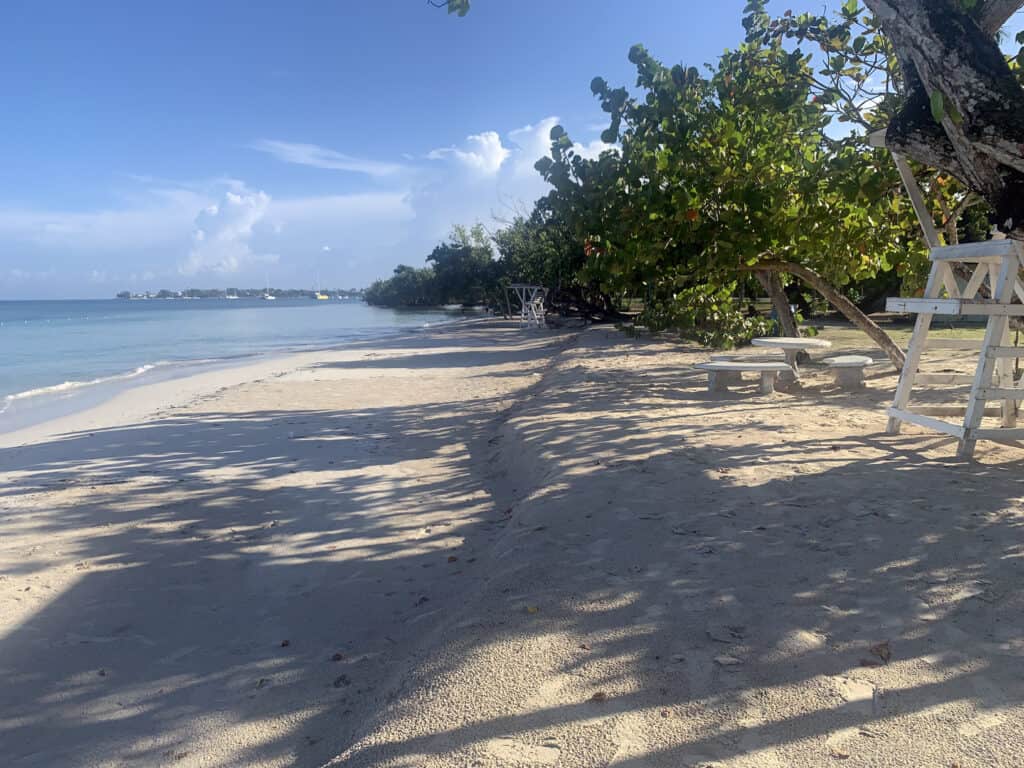
Harmony Beach Park: The Model Every Parish Needs
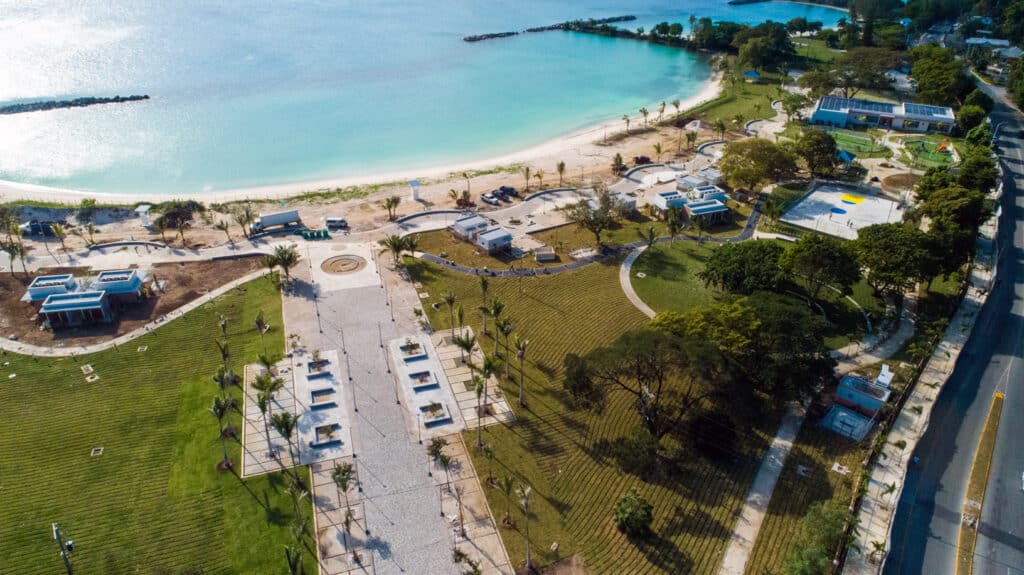
If there is one example of what public beach access should look like in Jamaica, it is Harmony Beach Park in Montego Bay.
Opened in May 2021, Harmony Beach Park is a free, public-access facility spanning 16 acres along Howard Cooke and Jimmy Cliff Boulevards, approximately seven minutes from Sangster International Airport. It was developed collaboratively by the Urban Development Corporation (UDC) with funding from the Tourism Enhancement Fund (TEF) and the Inter-American Development Bank (IDB), at a cost of approximately $1.3 billion JMD.
The park features white sand beach with a designated swimming zone and lifeguards, a 600-meter rubberized jogging trail, a basketball court, children’s play areas, outdoor showers, changing facilities, lockers, and benches throughout. Registered food vendors operate on-site (Suzie’s Beach Grill, Fyah Side Jerk, and others), and an ice cream shop serves visitors. The park is home to endemic Jamaican plant species planted throughout the grounds.
Entry is free. Parking costs $200 JMD per hour for cars and $400 for buses. The beach section is open Wednesday through Sunday, 9 AM to 5 PM. The park grounds are open daily from 6 AM to 10 PM. Security is visible and the facility is well maintained by UDC staff.
Harmony Beach Park is widely regarded as the best free beach in Montego Bay and possibly the entire island. It proves that the model works: a government-funded, professionally managed, free-access beach park with registered vendors, security, clean facilities, and a welcoming atmosphere for families, tourists, and locals alike.
The government has announced plans to replicate the Harmony Beach Park model in other parishes, including Negril, Boston Beach in Portland, Fantasy Beach Park in St. Ann, and Bob Marley Beach in Bull Bay. Whether these projects receive the funding and follow-through to match Harmony Beach Park’s standard remains to be seen.
Every parish in Jamaica should have a Harmony Beach Park. The infrastructure exists. The funding mechanisms have been proven. The demand is overwhelming. What is missing is the political will to prioritize public beach access at the same level as resort development.
Where You Can Actually Go to the Beach in Jamaica
For visitors and locals looking for accessible beaches, here is the practical reality as of 2026:
Negril (Westmoreland): 7 Mile Beach is publicly walkable end to end. Long Bay Beach Park (UDC) is free and open daily. Bluefields Beach Park (UDC) on the south coast of Westmoreland is operational with facilities.
Montego Bay (St. James): Harmony Beach Park is free. Dead End Beach (Buccaneer Beach) near the airport is free with minimal facilities. Doctor’s Cave Beach charges approximately $6 USD admission. Cornwall Beach is operational with a fee.
Ocho Rios (St. Ann): Turtle Beach (UDC) is operational. Dunn’s River Beach (UDC/St. Ann Development Company) is operational with fees. Cardiff Hall (Flavours) and Salem Beach (Sharkies) are operational.
Portland: Winnifred Beach is one of Jamaica’s prettiest free public beaches. Boston Beach (NRCA) has been rehabilitated and is operational.
South Coast: Treasure Beach (St. Elizabeth) has open, community-run beaches with a laid-back atmosphere. Bluefields Beach Park in Westmoreland is free and operational. Alligator Pond (Manchester) has beach/coast access points.
Kingston Area: Fort Clarence Beach (UDC, St. Catherine) is operational with facilities. Hellshire Beach is accessible.
Many beaches listed as “public” by NEPA require rehabilitation before they can safely be used. The full NEPA list includes 67 beaches across all parishes, but the operational ones with actual facilities represent a much smaller number.
What Visitors Can Do
The beach access crisis is gaining international attention. In May 2026, the documentary “Beach Inna Bondage: The Fight for Jamaica’s Coastline” premiered in Kingston, following the struggles of three frontline communities: Bob Marley Beach near Kingston, the Blue Lagoon in Portland, and Mammee Bay Beach on the North Coast. The film traces how the 1956 Beach Control Act, combined with Jamaica’s all-inclusive tourism model, has displaced communities, disrupted livelihoods, and degraded environments. It is the first major film to document the movement and has drawn significant attention to the issue both locally and internationally.
JaBBEM and local advocates have a simple ask for tourists: before booking a resort, ask whether a Jamaican citizen can walk across the beach in front of that property. If the answer is no, consider staying somewhere that supports open access.
Negril, with its walkable beach, locally owned restaurants, independent hotels, and beach bar culture, is the strongest example of what tourism looks like when it includes the local community rather than walling it off. Treasure Beach on the south coast operates on a similar community tourism model. Both destinations prove that visitors and locals can share the same sand without one group being excluded for the benefit of the other.
Stay at locally owned accommodations when possible (Jamaican Owned and Operated). Eat at independent restaurants. Book excursions with local operators. Walk the beach. Engage with the community. This is what responsible tourism looks like in Jamaica, and it is also, consistently, what travelers say was the best part of their trip.
FAQ
Are Jamaica’s beaches public?
Legally, the foreshore (the strip of sand between high and low tide) is Crown land under the Beach Control Act of 1956. It is not automatically public. The government can and does issue exclusive beach licenses to private operators, including all-inclusive resorts. In practice, many prime beach areas across the island are restricted to hotel guests only.
Can I walk the entire length of 7 Mile Beach in Negril?
Yes. 7 Mile Beach in Negril is publicly walkable from end to end. No resort can prevent you from walking along the sand. You cannot use resort facilities (chairs, pools, restaurants) without being a guest, but the beach itself is open. This is one of the few places in Jamaica where this is consistently the case.
What is the Beach Control Act of 1956?
A colonial-era law that declares all rights over the foreshore and the floor of the sea to be vested in the Crown. It grants no general public right to access beaches and allows the government to issue exclusive licenses to private operators. It has never been repealed despite Jamaica gaining independence in 1962. A new Beach Access and Management Policy was tabled in Parliament in March 2026 but has been rejected by advocacy groups as insufficient.
What is JaBBEM?
The Jamaica Beach Birthright Environmental Movement is a grassroots organization fighting for public beach access through legal action, advocacy, and community mobilization. They are currently involved in five court cases across the island seeking to secure beach access for Jamaicans. Their website is jabbem.org.
What is Harmony Beach Park?
A free, 16-acre public beach park in Montego Bay managed by the Urban Development Corporation. It features white sand beach, a jogging trail, children’s play areas, food vendors, lifeguards, and security. Entry is free. It opened in May 2021 and is widely regarded as the model for what public beach access should look like across Jamaica.
Do other Caribbean islands have this problem?
Most do not. Barbados, Antigua, the Dominican Republic, Costa Rica, and the US Virgin Islands all guarantee public access to beaches through their constitutions or specific legislation. Jamaica’s Beach Control Act is unusually restrictive compared to its Caribbean neighbors.
What happened with the fence on Negril Beach in April 2026?
A scuba operator who leased a section of UDC property on 7 Mile Beach erected a barbed wire fence from the road to the sea, blocking public passage along the beach. Local hotelier Winthrop Wellington discovered it during his morning jog and posted a viral video. The UDC removed the fence within one hour. The incident highlighted the importance of vigilance in protecting Negril’s open beach access.
How can I support beach access in Jamaica?
Stay at accommodations that support open beach access. Ask resorts whether Jamaicans can access the beach in front of their property before booking. Support locally owned businesses. Visit public beaches like Harmony Beach Park and Long Bay Beach Park. Follow JaBBEM at jabbem.org to support their legal and advocacy work.
What is “Beach Inna Bondage”?
A 2026 documentary by Kingston-based filmmakers Emiel Martens and Elsie Vermeer, made in collaboration with JaBBEM and Keznamdi. The 29-minute film follows three frontline beach access struggles in Jamaica: Bob Marley Beach, Blue Lagoon, and Mammee Bay Beach. It premiered in Kingston on May 2, 2026. The film examines how the Beach Control Act and Jamaica’s all-inclusive tourism model have displaced communities and concentrated coastal wealth in foreign hands. More information at caribbeancreativity.nl.
For more information on Negril beaches, restaurants, hotels, and activities, visit DiscoverNegril.com. Browse all business categories at discovernegril.com/negril-map/.