
The Negril Paradise Integrated Resort: What a $3 Trillion Development Means for a Town That Never Built Higher Than a Palm Tree
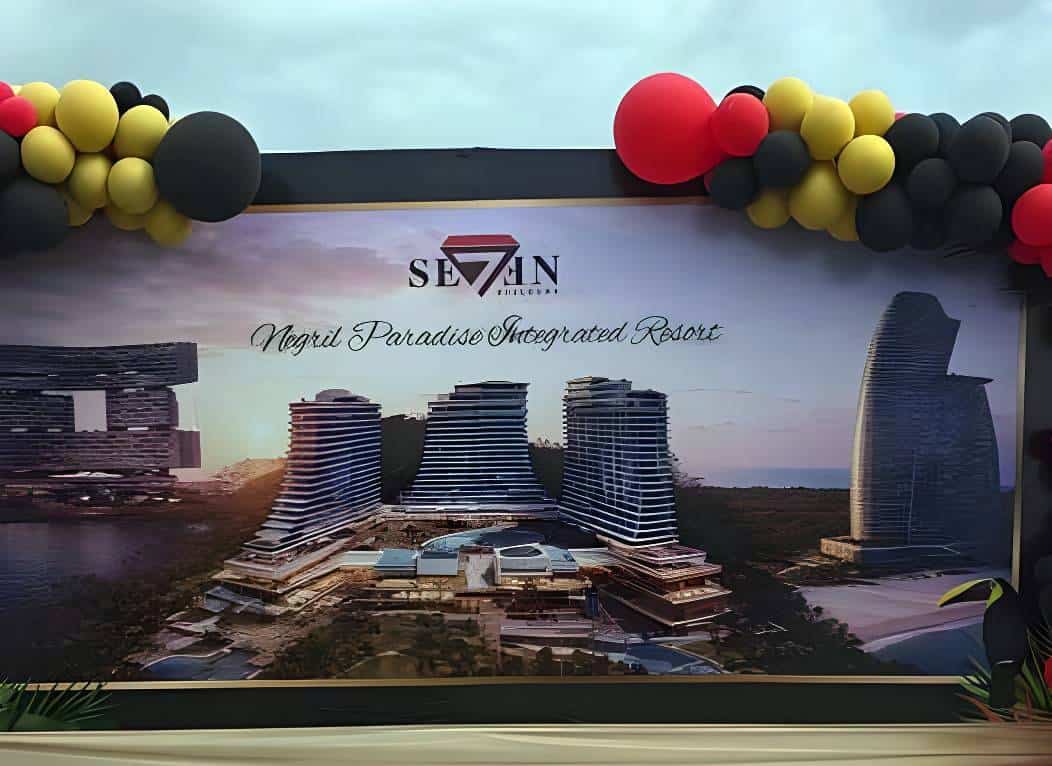
A development valued at roughly $22 billion USD, about $3 trillion JMD, is proposed for the West End of Negril. The Negril Paradise Integrated Resort, led by Seve7n Builders Jamaica Limited, would be the largest single private development in Jamaica’s history if it is built. Phase one covers 362 acres. The full vision spans approximately 1,000 acres over 15 years. It includes luxury hotel towers, a four-berth cruise ship terminal, a 1,100-bed hospital, a marina, branded residences, a casino, a convention centre, a sports complex, and what the developers describe as an underwater hotel experience.
A groundbreaking ceremony was held on the Negril West End on February 21, 2026. Minister of Labour and Social Security Pearnel Charles Jr attended. Shovels were placed in the earth and speeches were made about Jamaica’s resilience and future.
One detail tends to get lost in the spectacle of that ceremony. The project has not been approved. Speaking to the Jamaica Observer at the groundbreaking, Seve7n Builders CEO Marlon Howell said the development is still moving through the approval process and that he hoped to begin construction by year-end if the project is given the green light. A groundbreaking, in other words, is not a permit. And outside the ceremony, the reaction from the wider Negril community has been something closer to alarm.
What Is Being Proposed
Seven Builders Jamaica Limited is a Canadian-Jamaican development company led by CEO Marlon Howell, a Jamaican ordained minister who built his career in high-rise construction in Windsor, Owen Sound, and the Greater Toronto Area. The company has said the project is supported by local and overseas investors. The only financing arrangement that has been documented publicly is a 2022 agreement with a Vancouver investment firm, the details and limits of which are covered further below.
The development’s stated components include luxury hotel towers of a scale Negril has never seen, branded residences that the developers’ marketing associates with luxury automotive names such as Lamborghini and Bentley, a cruise ship terminal capable of handling four ships at once and up to 24,000 passengers per day, a 1,100-bed hospital with advanced trauma care, oncology treatment, and paediatric services, a marina, retail districts, entertainment venues, a sports complex, and an underwater hotel experience.
The project claims it will create 20,000 jobs, with 65 percent of the workforce drawn from local communities, and includes vocational training programmes. An affordable housing component targets a price point of roughly $10 million JMD per unit, with the developers stating they can construct concrete homes within 24 hours using advanced building methods. The entire development is proposed to run on 100 percent renewable energy through solar arrays, hydrogen micro-grids, advanced water recycling, and waste-to-energy systems.
The hospital carries the most emotionally charged promise. Every Jamaican child who walks through its doors, Howell told the audience, would be treated free of charge. He framed it not as marketing but as a covenant: no child turned away, no family forced to choose between a child’s life and financial ruin.
These are the developer’s stated claims. As of the groundbreaking, they are a vision presented for approval, not a built reality.
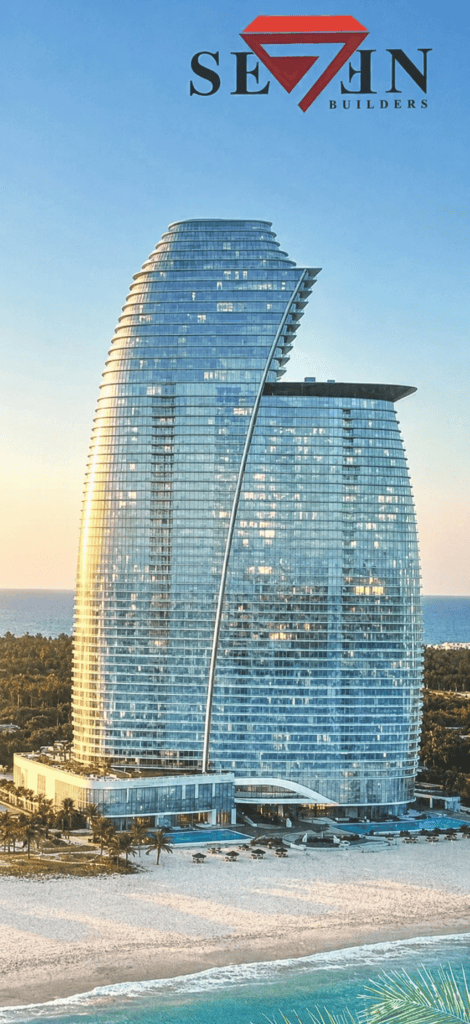
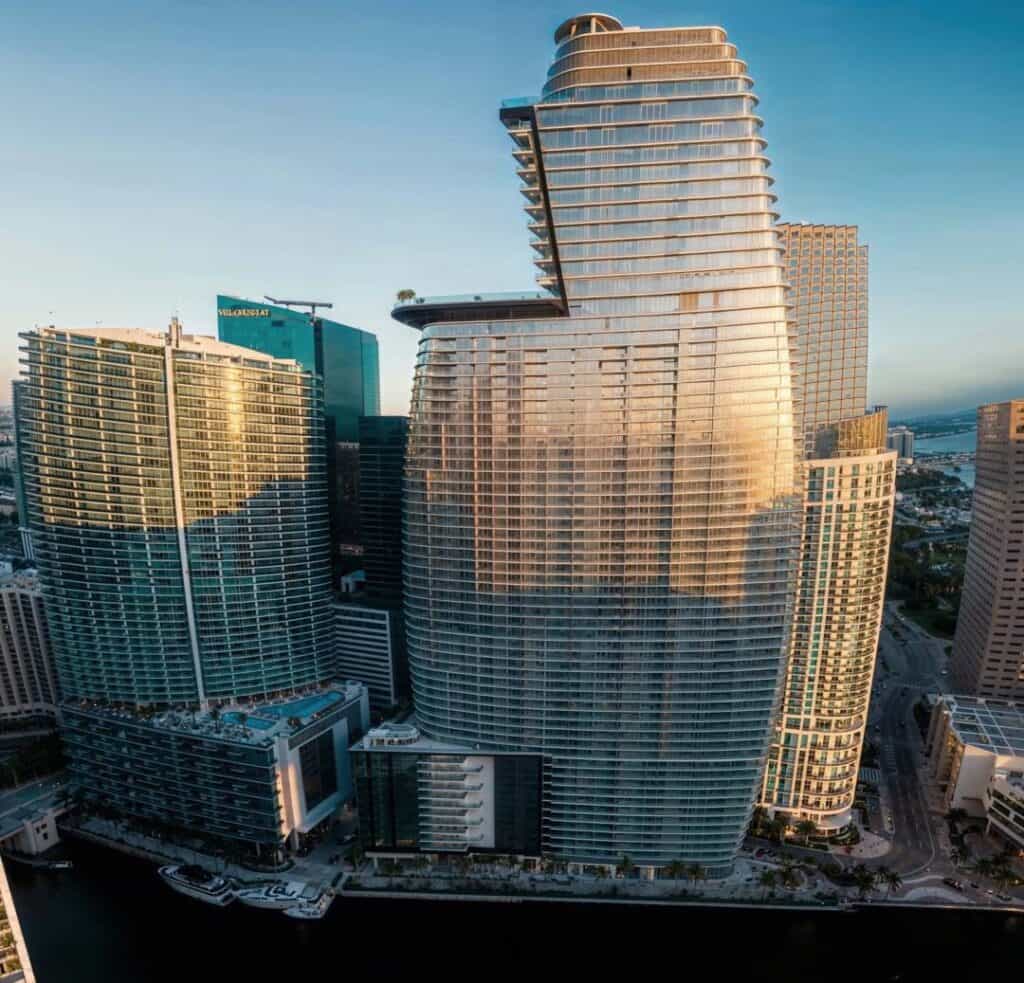
The tower image circulated on the Seven Builders groundbreaking invitation is not a rendering of the Negril project. It is the Aston Martin Residences in Downtown Miami, a 66-storey, 817-foot sail-shaped tower at 300 Biscayne Boulevard Way, designed by Bodas Miani Anger with Revuelta Architecture, developed by G&G Business Developments with the carmaker, and completed in April 2024 as the world’s first Aston Martin-branded residence. It has no documented connection to Seven Builders or to Negril. A developer proposing the largest private development in Jamaica’s history chose to illustrate it with a photograph of an existing building a thousand miles away.
This Land Has a History
The property where this development is proposed is not being developed for the first time. It is the Hogg family’s land at Wedderburns, part of Retreat Estate, deep in the West End beyond the Lighthouse, known locally for years as Hogg Heaven.
In 2007, a different developer took this same site through the full environmental review process. Negril Peninsula Resorts Limited, a United Kingdom based group with directors including David Walker and Charles Broomfield, submitted an Environmental Impact Assessment to the National Environment and Planning Agency under the name Negril Peninsula Resort. The engineering and EIA work was carried out by SPK Engineers Limited of Kingston. The EIA was submitted to NEPA on April 10, 2007, and a public presentation was held at the Negril Community Centre on May 8, 2007.
That earlier plan was large, but it was a different order of magnitude from what is proposed now. It called for approximately 6,228 habitable rooms on 361 acres. It is worth being precise here, because the figure is easy to misread. The 6,228 was a count of habitable rooms used for planning density, not a count of homes. The plan itself comprised 1,202 dwellings, ranging from villas and sea-view condos to apartments, alongside a marina, five new beaches, and three modest hotels. The total cost was put at in excess of 800 million US dollars. The current proposal, on essentially the same footprint, is valued at twenty-eight times that.
The 2007 project stalled when the global financial crisis arrived in 2008, and the site sat in limbo for well over a decade, a familiar feature of Negril’s development history. At the 2026 groundbreaking, Howell acknowledged the landowning families by name, holding a moment of silence for deceased members of the Hogg, Rawlings, and Glennister families, and described the current project as the fulfilment of a vision more than two decades in the making.
One point of clarification matters for accuracy. The neighbouring resort known as Secret Paradise sat immediately to the west of this land and was itself under construction in 2007. It is a separate property, not the subject site. The Seve7n Builders land is the Wedderburns parcel, which in 2007 was described in the EIA as largely undeveloped coastal basin and bush.
The 2007 EIA runs to several hundred pages and was prepared for a project with a marina but no cruise terminal, no hospital complex, and no towers. Given how dramatically the current scope exceeds it, a fresh environmental assessment would almost certainly be required. Whether a new EIA has been filed or approved for the current proposal has not been publicly confirmed.
The Palm Tree Rule and How Negril Lost It
For decades, Negril operated under a height restriction that began as custom and hardened into rule: no building could stand taller than the tallest coconut palm. This was never merely aesthetic. It defined Negril’s identity as the anti-resort, the Caribbean town that chose the horizon over the vertical concrete skylines of Cancun, Miami Beach, and Montego Bay. Visitors came precisely because it looked nothing like those places.
The 2007 record shows the rule already under strain, and it shows it in the developers’ own words. At the May 8, 2007 public meeting, a long-time visitor raised the coconut-tree standard directly and asked what had become of it. The audience confirmed it still existed. Developer Charles Broomfield, responding for Negril Peninsula Resorts, conceded that there had been “some relaxation” of the rule, but said the company’s intent was to “resurrect and continue that particular architectural and cultural approach,” with no buildings planned taller than the coconut trees they would plant on the site.
There are no buildings planned to be taller than the coconut trees that we will plant up there.
Charles Broomfield, developer, Negril Peninsula Resorts Limited
Public presentation, Negril Community Centre, 8 May 2007
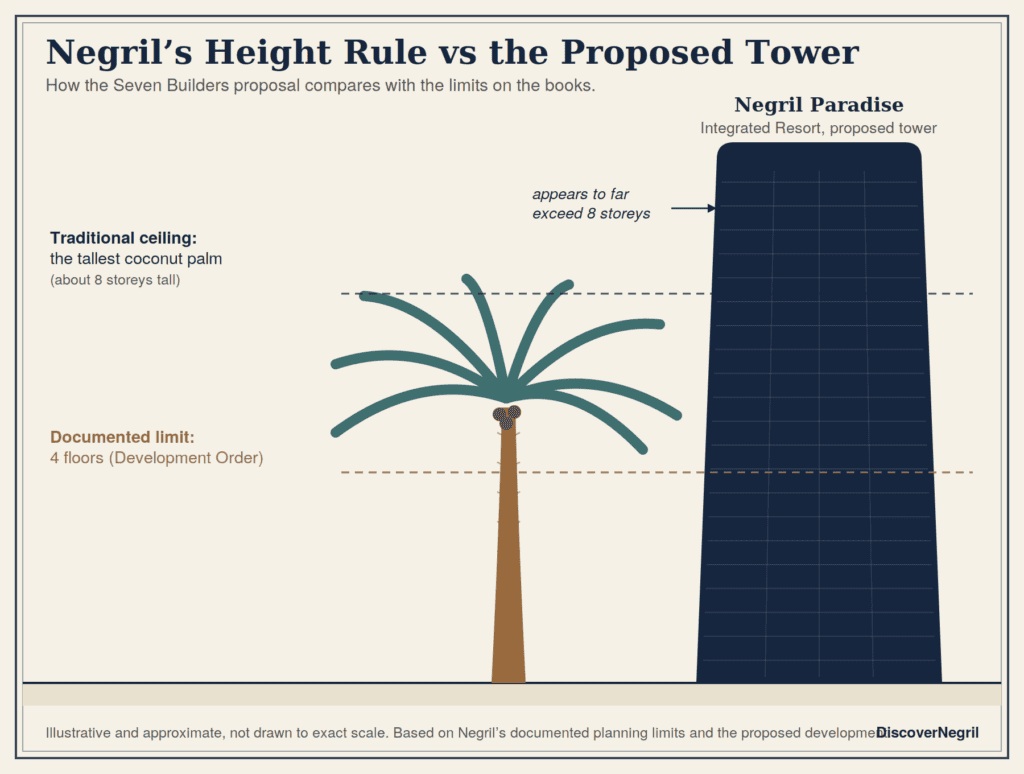
That exchange is the clearest documented marker of where the rule stood. Even an outside developer with a 361-acre plan committed, on the public record, to building beneath palm height. The same EIA notes that NEPA’s recommended maximum height for the site was four storeys, and that the developers proposed a maximum of three, with most buildings only one or two.
The regulatory picture only grew more tangled afterward. Reporting indicates that in 2013 the Minister responsible for land and environment, Robert Pickersgill, signed a Development Order for the area formalising a four-floor limit, a change described at the time as minor. Later accounts suggest the ceiling was pushed further, to as much as eight storeys, although documentation for that change has not been widely published. Layered together, the informal palm standard, NEPA’s four-storey recommendation, a local Development Order, and unverified accounts of an eight-storey ceiling, the result is a height regime that no one can state with confidence.
Into that uncertainty comes the Seve7n Builders rendering, which shows a tower that appears to exceed every one of those figures. The gap between what any documented order allows and what is being proposed raises the question at the centre of this story: what is the current legal height limit in Negril, and who approved it?
Where Exactly Is This?
The site is the Wedderburns parcel on the West End, beyond the Lighthouse, part of Retreat Estate, in Negril, Westmoreland. The 2007 EIA places it precisely, with the Secret Paradise resort adjoining to the west and Jackie’s on the Reef and the Pitkelleney subdivision to the east. The groundbreaking took place here, and community members identify the location the same way.
Some observers have asked whether the property sits within Negril proper or closer to Paradise Park, further south toward Savanna-la-Mar, which would matter because it could place the land under a different planning authority with different height rules and approval processes. The historical record weakens that theory. In 2007 the site was treated unambiguously as part of Negril and Westmoreland, and the Negril Green Island Area Local Planning Authority sat on the official list of consulted bodies for the project. By the documentation that exists, this is NGIALPA’s territory. The question can still be asked, but the 2007 paper trail answers it as Negril.
Either way, the scale of what is proposed would be visible from, and would press upon, the existing Negril community.
The Environmental Question
The 2007 EIA gives an unusually candid picture of the site’s marine context, and it is not flattering. It describes a fringing reef roughly 200 metres wide that had already suffered extensive damage from Hurricanes Ivan in 2004 and Emily in 2005, with the reef under severe coral stress, algae cover estimated at 95 percent, and very low fish numbers. The shoreline is iron-shore and fractured limestone cliff. Because there was no public sewage conveyance in the area, the plan called for an on-site treatment plant discharging hundreds of metres out to sea.
That assessment was prepared for a project with a marina for yachts and medium ocean-going vessels. It was not prepared for a four-berth cruise terminal handling four ships and up to 24,000 passengers a day. That is an entirely different environmental proposition. Cruise operations of that scale typically require dredging, generate significant marine pollution, and concentrate enormous numbers of people on a small stretch of coast. The renderings also appear to show a sandy beach on cliff-side, reef-adjacent coastline, which would imply artificial beach construction on exactly the kind of shoreline the 2007 study found already stressed.
The West End’s cliff geology, the same dramatic limestone that makes it one of Negril’s most celebrated features, is porous and fractured rather than uniform bedrock, which presents real engineering challenges at this scale. Whether a comprehensive modern EIA has been conducted for the expanded scope, whether NEPA has assessed the cruise terminal and tower components, and what conditions might attach to any approval, all remain publicly unanswered.
The Negril Paradox
This is where the story gets complicated.
For years, the Negril community has been formally asking for precisely the kind of investment this project promises. The Negril Chamber of Commerce’s 2019 “Negril 2030: Call for Action” identified the town’s most urgent needs: affordable housing for workers, an expanded healthcare facility, job creation, skills training, and infrastructure. The same priorities reappeared in the government’s 2026 Negril Destination Management Plan, a $47.4 billion JMD framework covering 98 projects over 15 years.
Seve7n Builders is offering versions of nearly everything on that list. A hospital. Housing. Jobs. Training. Infrastructure. Renewable energy. And the community’s response has been overwhelmingly negative.
The opposition centres on scale and character. Negril’s identity as the Capital of Casual was built on low-rise buildings, open sight lines to the sea, barefoot dining, and a deliberate rejection of the high-rise resort model. Visitors who have returned year after year for one or two decades chose it precisely because it was not Montego Bay, not Cancun, not Dubai. The proposed tower bears no visual relationship to anything standing in Negril today, and comparisons to Dubai have been made repeatedly, never as compliments.
But there is a divide in who opposes and who supports. The most vocal opposition comes from long-term visitors and returning tourists, many of them North American and European, who value Negril’s existing character. Among local residents and workers, the reception is more complicated. Construction jobs, permanent employment, healthcare access, and affordable housing are not abstractions for someone commuting in from Sheffield or Little London because they cannot afford to live in the town where they work. As one local business owner put it, the West End has been declining economically for years, and nostalgia does not pay anyone’s bills.
The government’s own position appears contradictory. Two weeks before the Seve7n Builders groundbreaking, the Ministry of Tourism presented a Destination Management Plan emphasising Jamaica-first ownership, boutique West End development modelled on Bali, transparent digital governance, and growth calibrated to Negril’s carrying capacity. The Seve7n Builders project, with its luxury-branded residences, foreign-investment structure, and 24,000-passenger cruise terminal, sits in plain tension with several of those principles. Yet a government minister attended the groundbreaking and pledged support.
The Infrastructure Question
The West End of Negril already struggles with consistent water supply, reliable electricity, and road maintenance. The Negril Chamber of Commerce has been requesting basic sidewalks, drainage, and road lighting for years. The existing infrastructure does not reliably serve the population that is already here.
This is not a new worry, and the 2007 record proves it. At that public meeting, named West End operators raised the water and sewage question pointedly. The proprietor of Negril Escape Resort warned that the area had endured severe water shortages and could not absorb a development of this size without consequences for existing properties. Another long-time resident catalogued past droughts, low pressure on the beach, and the failure of earlier promises. The National Water Commission’s own written position to the developer was that a reliable supply existed “but is not infinite,” and urged the company to act promptly “while supply still exceeds demand.” Sewage, the NWC made clear, was not its concern, because there was no public system to connect to.
Nearly twenty years later, the same site faces the same questions, attached to a project many times larger. A development of this magnitude would multiply demand on every utility. The developers’ claim of 100 percent renewable energy, if delivered, would address electricity. But water supply, sewage treatment, road capacity, and emergency services are not solved by solar panels. The proposed cruise terminal adds another layer: four ships docking at once would funnel up to 24,000 visitors onto a stretch of coast currently reached by a single two-lane road. Moving that volume of people, even for day visits, would require infrastructure that does not exist and is not part of any announced plan.
The Airport Connection
The viability of this development is closely tied to another major project, the proposed Little London International Airport.
Still in the planning and feasibility stage, the airport would sit roughly 15 to 20 minutes from Negril, eliminating the 90-minute road transfer from Sangster International in Montego Bay. The Airport Authority of Jamaica has confirmed that the existing Negril Aerodrome cannot be expanded into an international facility because of its proximity to the Great Morass. After evaluating 21 potential sites against criteria including safety, environmental impact, financial viability, and economic stimulus, the Authority selected Little London. The initial runway would measure 2,240 metres, enough to handle flights from as far as Canada. The project is estimated at $460 million USD, financed through a public-private partnership.
At the ThropX 2024 conference, Horus Bryson, Senior Director of Engineering, Maintenance and Projects at the Airport Authority of Jamaica, indicated that construction could begin by 2028, with a basic operational runway achievable within 24 to 36 months of starting. Initial passenger projections estimate 189,000 at startup, climbing to 1.23 million by 2047.
Seve7n Builders speakers at the groundbreaking referenced the airport directly as enabling infrastructure. If the airport does not proceed, the cruise terminal becomes the sole point of international access, a far more limited proposition. If both proceed, Negril shifts from a town reachable only by road from Montego Bay into one with its own international air and sea gateways. That would be the most significant change in Negril’s accessibility since the road from Montego Bay was paved.
The Financing Question
This is where the most important correction lies, and where the project’s credibility is most exposed.
The only documented financing connected to Seve7n Builders is a 2022 agreement with Alpina Investments Inc., a privately held, Vancouver-based investment firm. The figure attached to it is US$3.5 billion, roughly J$535 billion. That is a substantial sum. But two facts about that agreement matter more than the headline number.
First, it is not a Negril commitment. The 2022 Alpina agreement was an islandwide programme of eight projects spread across Montego Bay, St James, Discovery Bay, St Ann, and Hanover, with its announced first phase a five-star hotel in Montego Bay and completion of all eight targeted for late 2030. The Negril Paradise Integrated Resort is not named in it. So while Seve7n Builders and Alpina have a documented relationship, there is no publicly documented financing commitment specific to the $22 billion Negril project.
Second, $3.5 billion across eight projects in five parishes is a different thing from $22 billion on a single site on the West End. At the groundbreaking, the developers referenced JVR Capital Group International as strategic partners, and a Wall Street investor named Joel Miller spoke to the project’s potential, but no specific financing commitments beyond the Alpina relationship have been detailed publicly.
Mega-developments of this scale are normally built on phased financing, where each completed phase generates the revenue and confidence to unlock the next. Community observers have noted that, to date, Seve7n Builders has not completed a major construction project in Jamaica. The company’s website shows concept images for developments in Montego Bay and Discovery Bay, but no finished Jamaican work. The distance between a 2022 multi-parish memorandum and a $22 billion single-site build is the open question at the centre of the financing story.
What Happens Next
The project sits at the intersection of several unresolved questions. Has a new Environmental Impact Assessment been filed and approved by NEPA for the expanded scope? What is the current legal height limit in the NGIALPA area, and would the proposed tower comply? Is there any financing in place specific to the Negril project, beyond the islandwide Alpina relationship? And when will real construction begin, beyond the ceremonial groundbreaking? Howell himself has said the answer to that last question depends on approvals that have not yet been granted.
Community members point to a pattern in Negril’s development history: ambitious proposals, groundbreaking ceremonies, then silence. This very site sat in limbo for more than a decade after the 2008 crisis killed the earlier project. Whether Seve7n Builders breaks that pattern depends entirely on execution. As the Minister of Labour put it at the groundbreaking, the country has seen many visions and many desires, and the focus now must be on tangible achievement.
The community response also noted who was in the room. The former Negril Chamber of Commerce president, Damian Salmon, attended, as did police leadership and other local stakeholders. As one observer put it, attendance does not mean agreement. It means being informed.
The Bigger Picture
The Negril Paradise Integrated Resort cannot be read in isolation. It exists alongside the government’s $47.4 billion JMD Destination Management Plan, the proposed Little London International Airport, the diaspora-driven hotel-to-condo conversion trend, and the deeper tension between Negril’s identity as the Capital of Casual and its reality as a town without a high school, a proper sewage treatment plant, or a consistent water supply.
Each of these represents a different vision for what Negril becomes. The government plan emphasises Jamaica-first ownership, sustainable growth, and transparent governance. The diaspora conversion trend favours boutique-scale projects that preserve the existing character. The Seve7n Builders proposal is a fundamentally different model: large-scale, foreign-investment-driven, vertically ambitious, and designed to compete with global destinations rather than complement the existing town.
Whether these visions can coexist, or whether one will define Negril’s next chapter, is the question the community will be living with for years. What is certain is that the decision is being made now. Not in 15 years. Now. In the permits that are granted or denied, the height limits that are enforced or amended, and the infrastructure investments that are prioritised or deferred. Negril’s future is not being settled by a master plan or a groundbreaking ceremony. It is being settled by what gets built next.
FAQ
What is the Negril Paradise Integrated Resort?
A proposed mixed-use development valued at roughly $22 billion USD on the West End of Negril, led by Seven Builders Jamaica Limited. It includes luxury hotel towers, a four-berth cruise ship terminal, a 1,100-bed hospital, a marina, branded residences, a casino, a convention centre, and affordable housing. A groundbreaking ceremony was held in early 2026, though the project remains in the approval stage.
How big is the development?
Phase one covers 362 acres. The full vision spans approximately 1,000 acres over a 15-year timeline, with a total projected investment of about $22 billion USD, roughly $3 trillion JMD.
Where exactly will it be built?
On the Wedderburns parcel on the West End, beyond the Lighthouse, part of Retreat Estate, in Negril, Westmoreland. The adjoining Secret Paradise resort lies to the west and Jackie’s on the Reef to the east. The 2007 planning record treats the site as within Negril and within the Negril Green Island Area Local Planning Authority.
What happened to the previous project on this land?
In 2007 the same site was taken through a NEPA Environmental Impact Assessment under the name Negril Peninsula Resort, by a United Kingdom based developer, Negril Peninsula Resorts Limited. That plan called for about 6,228 habitable rooms, comprising 1,202 dwellings, on 361 acres, with a marina, at a cost in excess of 800 million US dollars. It stalled after the 2008 global financial crisis and the site sat idle for more than a decade.
What is the height limit in Negril?
It is genuinely unsettled. The original standard was that no building should exceed the tallest coconut palm. The 2007 EIA records NEPA’s recommended maximum as four storeys, and reporting indicates a 2013 Development Order formalised a four-floor limit. Later accounts suggest the ceiling was pushed to eight storeys, though documentation has not been widely published. The Seven Builders rendering shows a tower that appears to exceed all of these.
Will there be a new airport in Negril?
The Little London International Airport is in the planning stage. The Airport Authority of Jamaica has selected the site and completed feasibility work. Construction could begin by 2028, with a basic operational runway achievable within 24 to 36 months. The estimated cost is $460 million USD.
How many jobs will the resort create?
The developers claim 20,000 jobs, with 65 percent of the workforce drawn from local communities, across construction, hospitality, healthcare, marine operations, retail, and administration. This is the developer’s projection.
Will children really be treated for free at the hospital?
The developers have stated that every Jamaican child who enters the proposed 1,100-bed hospital would be treated free of charge. No details have been shared publicly about how the ongoing operating costs of a facility that size would be funded.
Is this project definitely going to happen?
No. A groundbreaking ceremony has taken place and government ministers have expressed support, but the CEO has confirmed the project is still in the approval process. Open questions remain about environmental approvals, height compliance, financing specific to the Negril project beyond the 2022 islandwide Alpina relationship, and construction timelines. The same site had a previous proposal that was abandoned after the 2008 recession.
Sources: Addendum No. 1 to the Environmental Impact Assessment, Negril Peninsula Resort (SPK Engineers Ltd, 2007); Jamaica Observer coverage of the Negril Paradise Integrated Resort groundbreaking (2026); Jamaica Observer, “$535-b investment targeted” (December 2022).
For more on Negril’s development trajectory, read The Negril 2045 Plan: Does the Government’s $47 Billion Investment Actually Address What Negril Has Been Asking For? and Hotel-to-Condo Conversions in Negril. For information on Jamaica’s beach access laws and coastal development, read Jamaica’s Public Beaches Are Disappearing. Browse all Negril businesses at DiscoverNegril.com.