
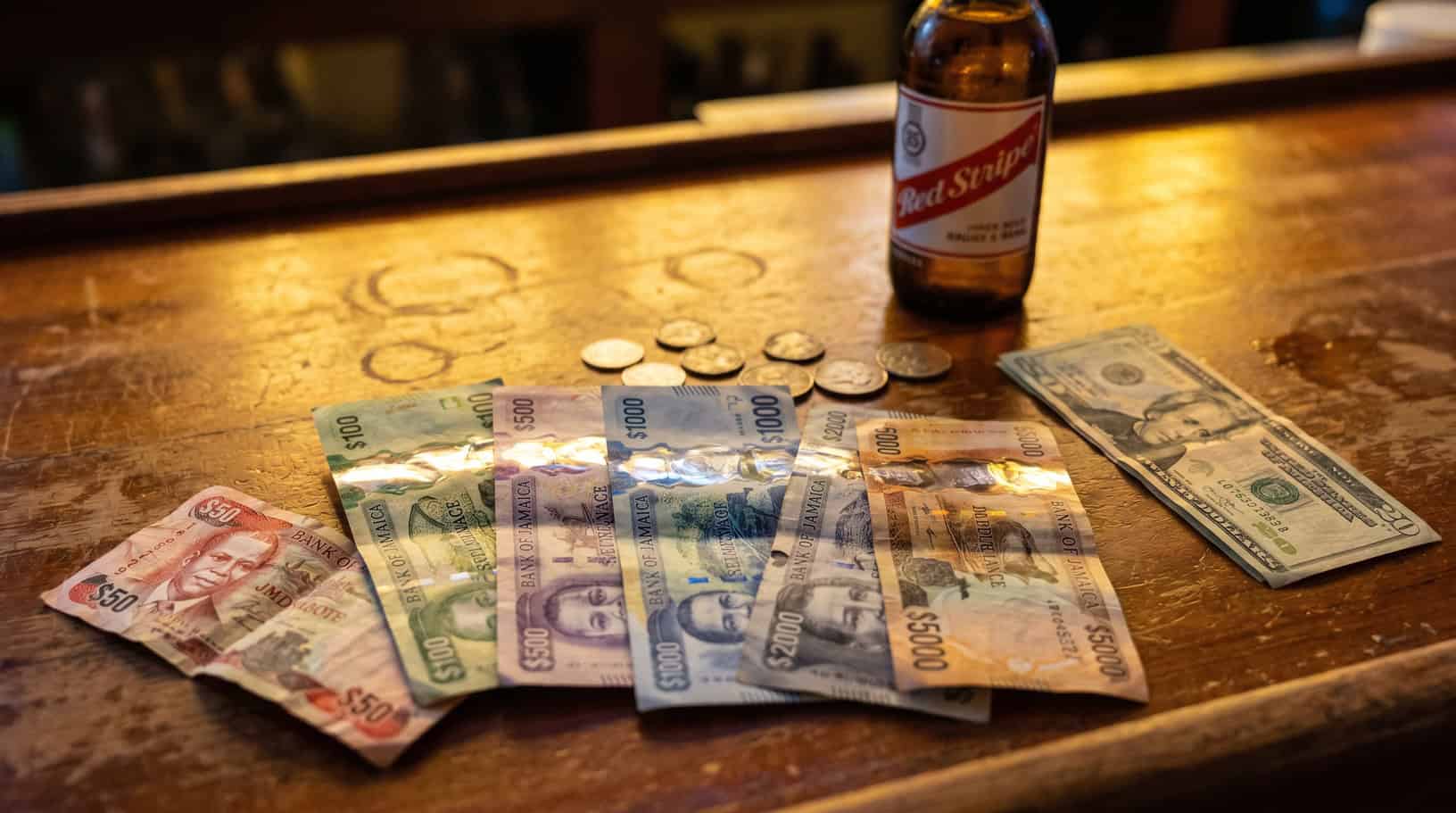
Why Does Jamaica Use US Dollars? The Currency Problem Nobody Talks About
Last Updated: May 2026
Jamaica’s official currency is the Jamaican dollar (JMD). But if you visit Negril, Montego Bay, or Ocho Rios, you will find restaurants listing prices in USD, hotels quoting rates in USD, and excursion operators charging in USD. Jamaica has not officially adopted the US dollar. What has happened is something economists call unofficial dollarization: an entire tourism economy has quietly switched to pricing in a foreign currency while the local currency still technically exists. For non-American visitors, particularly Canadians, this creates a problem. You are paying in a currency that is not yours, for goods in a country that does not officially use it, at exchange rates that benefit everyone except you. This guide explains how Jamaica got here, what it means for your wallet, and how to spend smarter when you visit.
A Currency That Lost 99% of Its Value
The Jamaican dollar was introduced on September 8, 1969, replacing the Jamaican pound as part of the country’s move to decimalization after independence in 1962. At launch, 1 JMD was roughly equivalent to 1 USD. The two currencies traded near parity.
Today, 1 USD equals approximately 158 JMD. That means the Jamaican dollar has lost over 99 percent of its value against the US dollar in 55 years.
This did not happen overnight. It happened in waves. Elevated inflation through the 1980s and especially the early 1990s drove sustained devaluation. IMF structural adjustment programs required currency liberalization. The Bank of Jamaica shifted from a pegged rate to a managed float, meaning the exchange rate is now determined by market forces rather than a fixed government rate. Each decade brought another leg down.
The result: Jamaicans themselves lost confidence in their own currency as a store of value. Businesses, particularly in tourism, started quoting prices in USD because the dollar held its value while the JMD did not. Savings accounts in USD became more attractive than JMD accounts. Real estate transactions, as covered in our property buying guide, are almost universally quoted in USD. The currency that was supposed to represent Jamaica’s economic independence after colonial rule became a symbol of dependence on the American dollar.
Jamaica Is Not Alone
Before pointing fingers at Jamaica, it is worth understanding that USD dominance is a global phenomenon. The US dollar comprises roughly 58 percent of all global foreign exchange reserves held by central banks, far exceeding the euro (20 percent) and the Japanese yen (6 percent). It is the world’s most traded currency and the default pricing currency for oil, gold, and most international commodities.
Several countries have gone further than Jamaica and officially adopted the US dollar as their primary currency:
| Country/Territory | Year Adopted | Reason |
|---|---|---|
| Ecuador | 2000 | Financial crisis, hyperinflation |
| El Salvador | 2001 | Economic stability |
| Panama | 1904 | US trade ties, Panama Canal |
| Zimbabwe | 2009 | Hyperinflation destroyed local currency |
| Timor-Leste (East Timor) | 2000 | Post-independence stability |
| British Virgin Islands | N/A | British Overseas Territory, US trade ties |
| Turks and Caicos Islands | 1973 | Replaced Jamaican dollar with USD |
| Micronesia | N/A | Compact of Free Association with US |
| Palau | N/A | Compact of Free Association with US |
| Marshall Islands | N/A | Compact of Free Association with US |
| Bonaire, Sint Eustatius, Saba | 2011 | Adopted after Netherlands Antilles dissolution |
Beyond these, the US dollar is widely accepted alongside local currencies in the Bahamas (at 1:1 parity with the Bahamian dollar), Cambodia (over 80 percent of deposits and loans are in USD), Belize, Costa Rica, Honduras, Nicaragua, and throughout the Caribbean tourism belt.
Jamaica sits in a grey zone. It has not officially dollarized. The Jamaican dollar remains legal tender. The Bank of Jamaica still sets monetary policy. But in practice, the tourism economy operates on a dual-currency system where USD is preferred, and the exchange rate gap between what a tourist pays and what the transaction is worth creates a hidden tax on every purchase.
How USD Took Over Negril
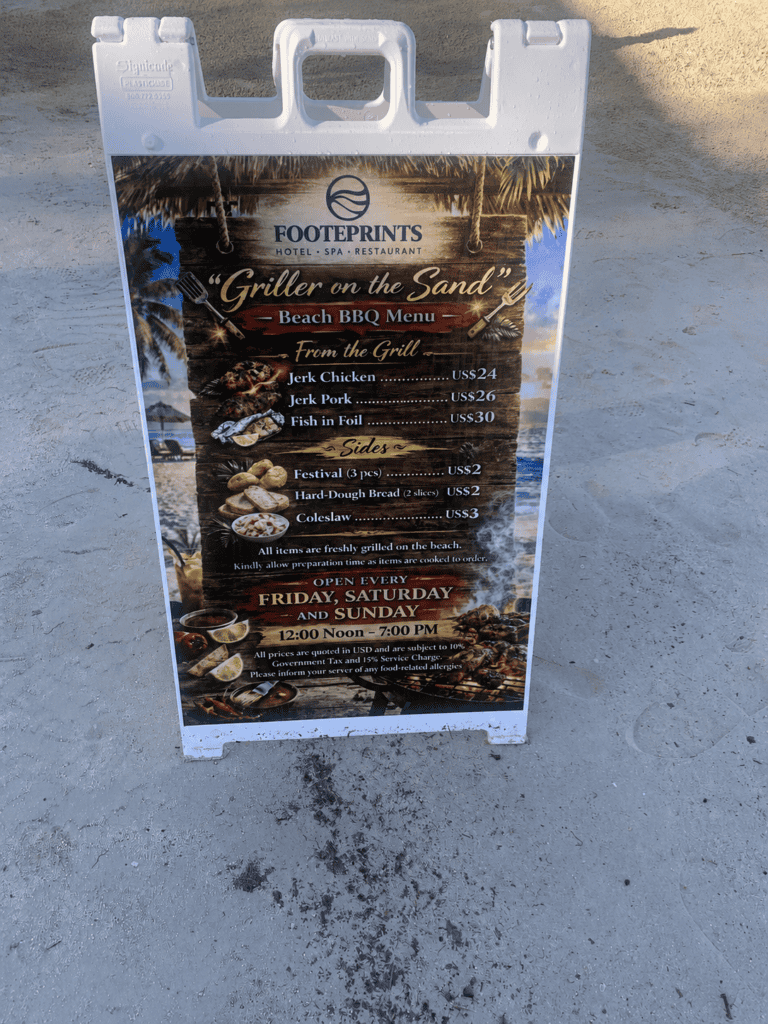
Walk into a restaurant on Norman Manley Blvd in Negril. The menu says “Jerk Chicken Dinner: $20.” Twenty US dollars for jerk chicken, rice, and a drink.
This pricing convention did not exist 20 years ago. It emerged as the JMD weakened and tourism became Jamaica’s dominant economic engine. In 2024, Jamaica’s tourism sector generated $4.3 billion USD from 4.3 million visitors. The government’s target for 2025 is $5.2 billion. Tourism is the single largest source of foreign exchange for the country.
When your economy depends on foreign visitors spending foreign currency, the incentive to price in that foreign currency is overwhelming. A restaurant owner who prices in USD does not have to worry about exchange rate fluctuations wiping out their margins. A hotel that quotes room rates in USD can plan their budget with certainty. An excursion operator who charges in USD can pay their fuel and equipment costs (also priced in USD on the international market) without conversion risk.
The all-inclusive resort model accelerated this. Sandals, Couples, RIU, Royalton, and the other major chains bill entirely in USD. Their guests never touch Jamaican currency. They arrive, stay within the resort walls, and leave without ever engaging with the JMD economy. This created a parallel economy where USD is the operating currency and JMD is what the staff earn and spend outside work.
The tipping culture reinforced it. Tourism workers, who are among the lowest paid in Jamaica, depend on tips. American tourists tip in USD. So when a Canadian tourist tips in their local currency or in JMD, it is worth less to the worker. Over time, “tip in USD” became the default advice in every travel forum. Which means non-American tourists now feel pressured to acquire USD before visiting a country that officially uses JMD.
The Canadian Squeeze
This is where it gets personal. As a Canadian, Jamaica’s USD pricing creates a double conversion problem that most travel guides never mention.
Here is the math. A Canadian visiting Negril in May 2026 faces these exchange rates:
1 CAD = approximately 0.72 USD 1 USD = approximately 158 JMD 1 CAD = approximately 114 JMD
When a restaurant charges $20 USD for a jerk chicken dinner, a Canadian is paying $27.78 CAD. For jerk chicken. In a developing Caribbean nation.
Compare that to Colombia, where $20 USD worth of food buys a multi-course meal with drinks. Or Mexico, where the same amount covers a full dinner for two at a mid-range restaurant. Or the Dominican Republic, where the local peso is used everywhere and prices reflect the local economy, not a foreign one.
The Canadian dollar has no special relationship with the US dollar. Canadians do not earn in USD. When a Canadian traveler acquires USD before a Jamaica trip, they lose on the CAD-to-USD conversion. Then they spend that USD in Jamaica at prices inflated for the American tourist market. Then they receive change in JMD at whatever rate the business decides to give, which is almost never the bank rate. Every transaction involves a conversion loss, and that loss compounds across a week of meals, taxis, excursions, and tips.
For context, I spent five years traveling Colombia precisely because the Canadian dollar has real purchasing power there. The Colombian peso is priced for the local economy, not for American tourists. Jamaica, the country my parents were born in and I know very well, has become more expensive for me as a Canadian than countries where I have no cultural connection at all.
Who Benefits, Who Loses
American tourists benefit. Everything is priced in their home currency. No conversion math, no exchange rate anxiety, no confusion at the register. Jamaica is, functionally, a domestic spending experience for Americans.
Hotel chains and resort operators benefit. Revenue in USD means stable, predictable earnings that translate cleanly to their corporate balance sheets in North America or Europe. No currency hedging required.
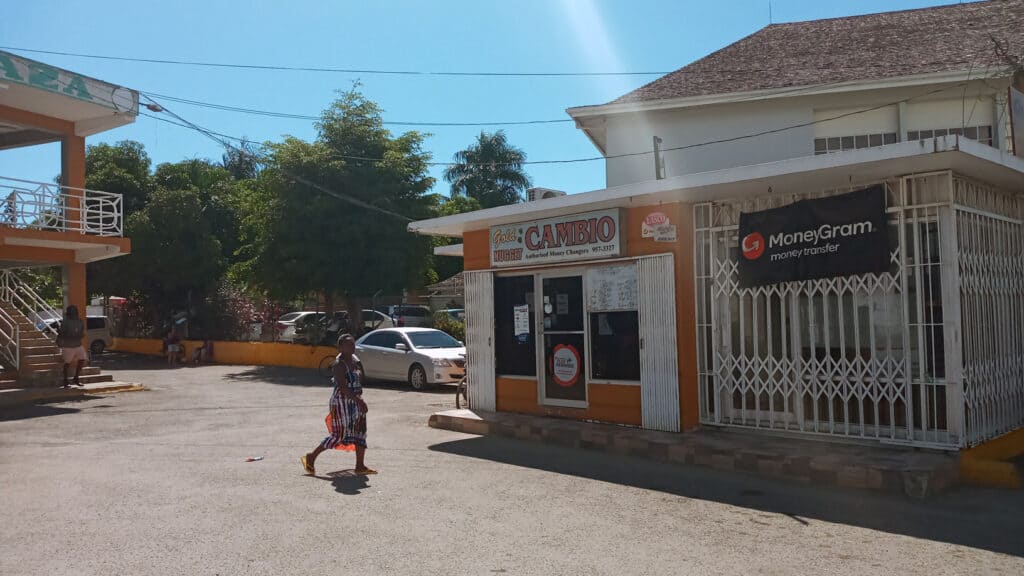
Cambios (exchange houses) benefit. The spread between the buy rate and the sell rate is their profit margin. The wider the gap between what a tourist gets when exchanging and what the official rate is, the more the cambio earns. A tourist getting 150 JMD per USD when the bank rate is 158 is losing 5 percent on every dollar exchanged. Multiply that across thousands of transactions per year.
Jamaicans lose. Tourism workers earn in JMD but live in an economy where imported goods (fuel, food, medicine, building materials) are priced relative to the USD. When the JMD weakens, their purchasing power drops. The government estimates that 60 cents of every tourism dollar leaves Jamaica to cover imports, debt service, and repatriated profits. Only 40 cents stays in the local economy.
Non-American tourists lose. Canadians, British, Europeans, and visitors from other Caribbean nations are paying a premium driven by USD pricing that does not reflect the actual cost of goods in Jamaica. A plate of jerk chicken does not cost $20 to produce. It costs that because the menu is calibrated to what an American tourist will pay without flinching.
The IMF Says De-Dollarize
In its latest country report on Jamaica, the International Monetary Fund recommended that the Bank of Jamaica step back from actively managing the foreign exchange market and allow the JMD to find its own level through supply and demand. The IMF’s reasoning: Jamaica has earned the right to trust its own currency. Debt is down to about 70 percent of GDP (from nearly 150 percent in 2013). Inflation is within the Bank of Jamaica’s target range at around 5 percent. Foreign reserves cover 7 months of imports. Unemployment is at a record low 3.7 percent.
The practical implication: if businesses priced in JMD instead of USD, tourists would see real prices that reflect the local economy. The exchange rate would do its job of making Jamaica competitive for all visitors, not just Americans. Jamaican workers would see their wages hold value instead of watching the JMD slide year after year. And the Bank of Jamaica could stop burning foreign reserves to prop up a rate that the market would set naturally.
Whether this actually happens depends on political will, business incentives, and how quickly exporters and tourism operators can adjust. The IMF acknowledged it will be a bumpy transition. Currency fluctuations will increase in the short term. Importers of fuel, medicine, and machinery will feel it first. But the long-term outcome, an economy that operates in its own currency and prices goods for its own reality, is what Jamaica needs.
Practical Money Guide for Visitors
Until de-dollarization happens (and it may take years), here is how to spend smarter in Jamaica:
Bring JMD for local businesses. Jerk stands, local shops, route taxis, and small vendors operate in JMD. You will get better value paying in the local currency at these places. Some businesses give a poor exchange rate when you pay in USD, sometimes as low as 100 JMD per 1 USD when the real rate is 158. That is a 37 percent markup.
Use USD for tourist-facing businesses. Resorts, major restaurants, excursion operators, and airport transfers quote in USD. Paying in JMD at these places can actually cost you more because the business sets their own conversion rate, which may not be in your favour.
Bring small USD bills for tips. Ones and fives. Tourism workers prefer USD for tips because it holds value better than JMD. This is the reality of the current system, whether or not it should be.
Canadians: do not buy USD at the airport. The conversion spread at airport exchange counters is brutal. Use your bank to order JMD before you travel, or withdraw JMD from an ATM in Jamaica. If you need USD, buy it from your home bank at the best rate you can get before departure.
Use a no-foreign-transaction-fee credit card. Visa and Mastercard set exchange rates close to the interbank rate. A credit card with no foreign transaction fee gives you the best conversion rate available, better than any cambio or cash exchange.
Uber is an option other than taxis and charges through the app. No cash negotiation, no currency confusion. The fare is set before you confirm, and payment is handled digitally. Uber launched in Negril in 2024 and the price difference versus charter taxis is significant.
FAQ
Does Jamaica officially use the US dollar?
No. The Jamaican dollar (JMD) is the official legal tender. However, the US dollar is widely accepted throughout the tourism sector, and many businesses price their goods and services in USD. This is known as unofficial dollarization.
Why do Jamaican businesses price in US dollars?
The Jamaican dollar has lost over 99 percent of its value against the USD since its introduction in 1969. Businesses in the tourism sector price in USD for stability, because their costs (imports, fuel, equipment) are tied to the USD, and because the majority of their customers are American.
Should I bring US dollars or Jamaican dollars to Jamaica?
Bring both. USD for tourist-facing businesses, excursions, tips, and hotels. JMD for local vendors, route taxis, street food, and small shops. The best approach is to use a credit card with no foreign transaction fee for major purchases and carry small bills in both currencies for cash transactions.
What is the current exchange rate?
As of May 2026, approximately 158 JMD per 1 USD. This fluctuates daily. Check xe.com or your bank for the current rate before exchanging money. Cambios in Jamaica may offer rates 5 to 10 percent below the official rate.
Is Jamaica expensive for Canadians?
Yes, relative to other Caribbean destinations. Because Jamaica’s tourism economy prices in USD, Canadians face a double conversion loss (CAD to USD, then spending USD at inflated tourist prices). Countries like Colombia, Mexico, and the Dominican Republic offer significantly more purchasing power for the Canadian dollar.
What is the IMF recommending for Jamaica’s currency?
The IMF’s latest report recommends that the Bank of Jamaica reduce its intervention in the foreign exchange market and allow the JMD to float more freely. The goal is to encourage businesses to price in JMD rather than USD, which would make Jamaica’s economy more transparent and competitive for all visitors.
What countries officially use the US dollar?
Outside of US territories, 11 countries and territories have officially adopted the USD: Ecuador, El Salvador, Panama, Zimbabwe, Timor-Leste, British Virgin Islands, Turks and Caicos Islands, Micronesia, Palau, Marshall Islands, and Bonaire/Sint Eustatius/Saba.
Can I use my Canadian credit card in Jamaica?
Yes. Visa and Mastercard are widely accepted at hotels, restaurants, and major businesses. The charge will be converted at the interbank rate (the best rate available). Make sure your card has no foreign transaction fee, otherwise you will pay an additional 2.5 percent surcharge on every purchase.
For more information on Negril restaurants, hotels, excursions, and local resources, visit DiscoverNegril.com. Browse all business categories at discovernegril.com/negril-map/.